Analysis project
EMF House Analysis
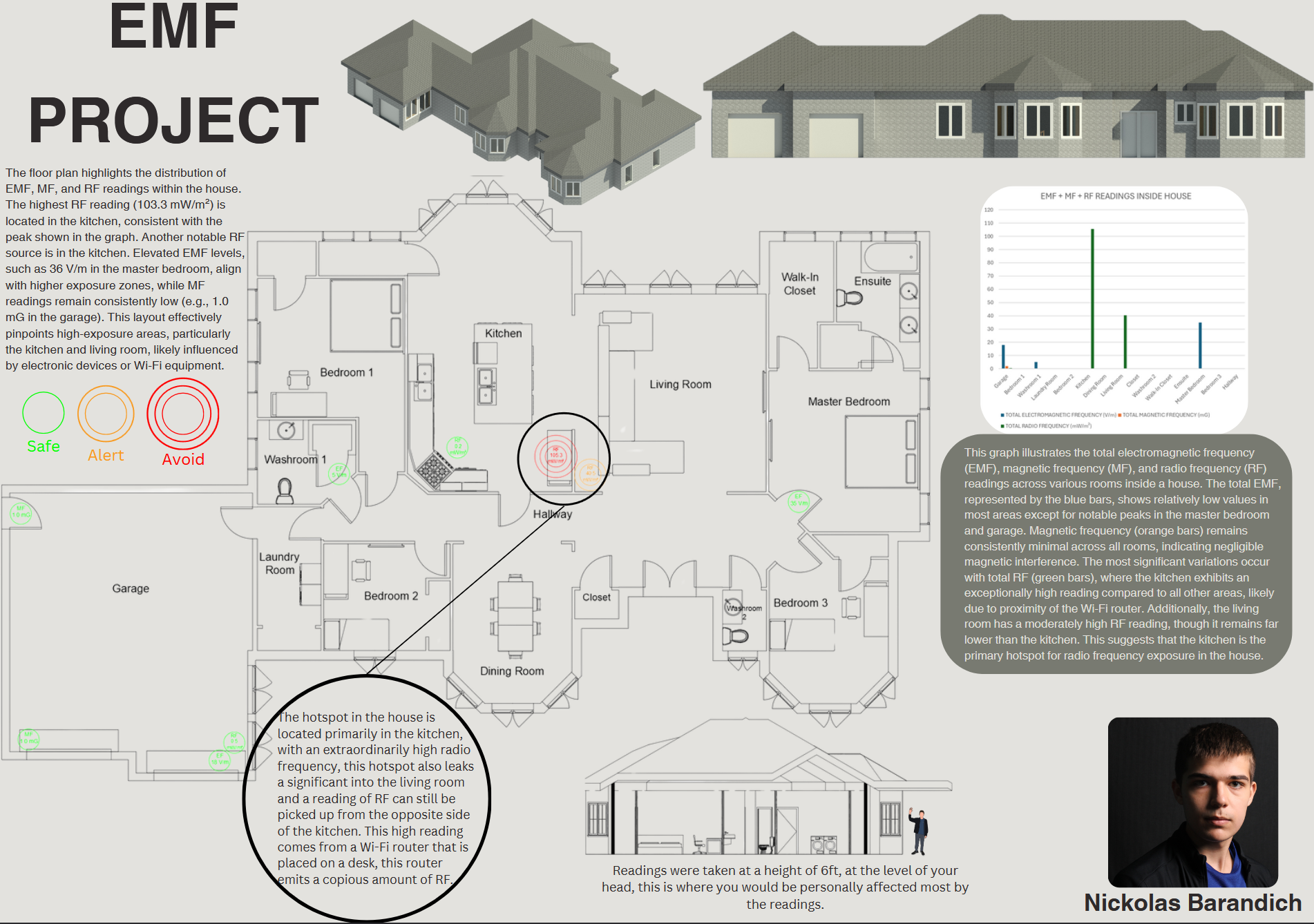
This project was centered on drafting, building modeling, measurement methodology, and analysis. I recreated a fully furnished floor plan of my house in AutoCAD, built a matching 3D Revit model, and used both to organize and explain EMF readings by room and location.
Overview
Turning raw physical measurements into a structured spatial analysis.
I started by recreating a fully furnished floor plan of my house in AutoCAD, then built a corresponding 3D Revit model so the measurements could be mapped onto an accurate spatial representation of the home. That gave the project a stronger analytical foundation than a simple spreadsheet of readings would have on its own.
Technical highlights
Drafting and building model reconstruction
Recreated the home's floor plan in AutoCAD and translated it into a 3D Revit model so room layout, furniture placement, and measurement locations could be interpreted in context.
Measurement organization
Collected EMF readings throughout the house, organized the data in Excel, and compared results by room and location rather than treating them as isolated values.
Presentation-driven analysis
Built a final presentation that made the readings easier to understand and showed how residential layout, device placement, and room usage influenced exposure.
Why it mattered
Although this was not a manufacturing project, it still demonstrates a strong mechanical-design workflow: technical drafting, 3D modeling, measurement methodology, structured documentation, and the ability to convert physical observations into a clear engineering-style explanation.
The value of the project came from the connection between space and data. The models made it possible to compare readings in a way that was visually understandable and grounded in the actual layout of the house.
Media and artifacts
The final presentation ties together the AutoCAD floor plan, Revit model views, room-based EMF readings, and the engineering explanation behind the observed patterns.